Almost everyone is wary of “fragmented information.” But look closely: what most people mean by fragmentation is along the time axis — two minutes waiting for the elevator, half an hour on the subway, filled with one short piece of content after another.
Fragmented time is only the surface. What deserves real vigilance is fragmented themes.
Sort the ways we take in information along two axes — time and theme — and you get four quadrants:
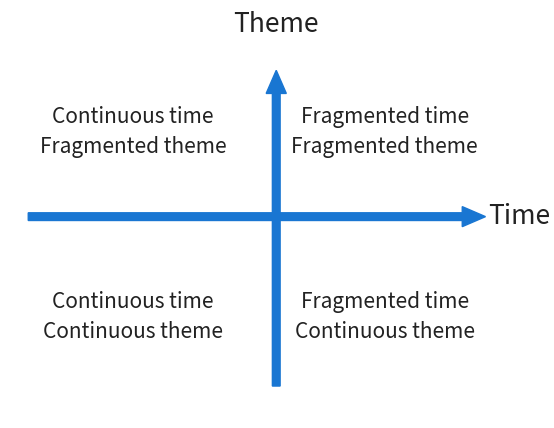
Fragmented time, fragmented theme. Scrolling Weibo or Zhihu on the commute: the time is already broken, and so is the content. This is the most common state, and what most people picture as “fragmentation.” It is not good, but the harm is limited — what breaks is time you could not have used anyway.
Continuous time, continuous theme. Setting aside a whole block on the weekend to read a book or dig into a topic. The agreed-upon ideal; no need to say more.
Continuous time, fragmented theme. Having a whole block of time and spending it on short videos that flash by. This is the quadrant that deserves the most vigilance. A block of time is a scarce resource; it could have been traded for complete understanding, but instead it gets shredded and fed to unrelated themes. Worse, this is exactly where many people live: vigilant about wasting fragmented time, while wasting whole blocks with their own hands.
Fragmented time, continuous theme. Reading the same book at different times, following the same field. The two minutes at the elevator and the half hour on the subway get strung together, because the theme is one continuous line. Little adds up; broken time can still complete a whole accumulation. This is how you get ahead of most people.
With the four quadrants side by side, the conclusion is clear: fragmented time is not scary; fragmented themes are. If time breaks while the theme stays continuous, the fragments can be woven into cloth; if time stays whole while the themes scatter, the block dissolves into sand.
So the source that “Clear Source” needs to clear is not time, but theme. The practice is simple: keep one or two long-term things for yourself — a book, a topic — that any fragment of time can pick up and continue; when taking in information, don’t look at recommendations, look at the themes you are tracking.