
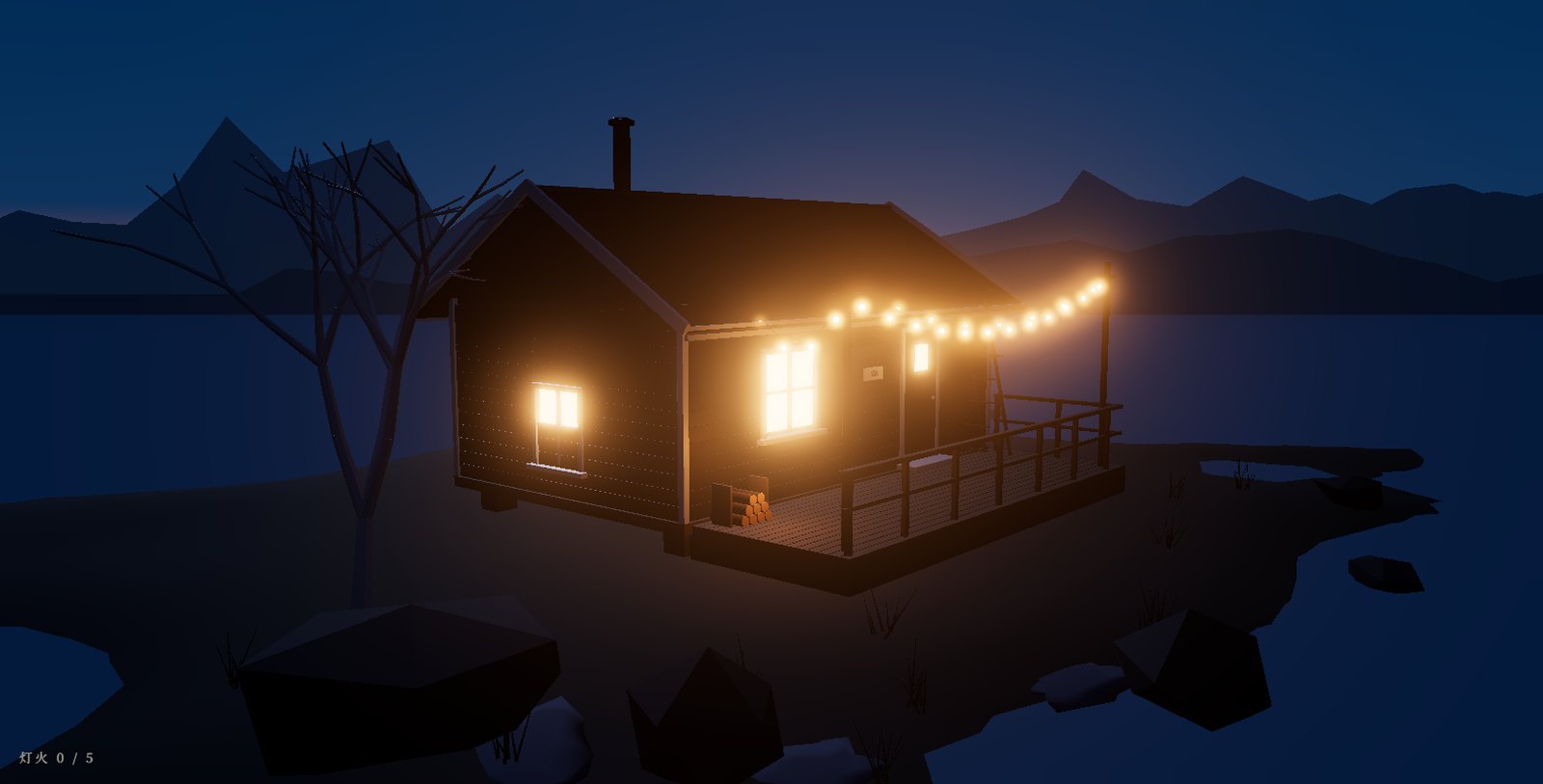
The second 3D personal site, after the Atlas of Collections: a small wooden cabin by a Norwegian fjord, in that blue twenty minutes after sunset. Inside it hides my experiences, my writing and my projects — every treasure you find lights one more lamp. This article records the whole journey from idea to launch.
Try it live →(project page →)(best on desktop, with headphones)
Where it started: from “looking at the atlas” to “stepping into a house”
The Atlas answered the question “what shaped me” — but an atlas is seen from above, everything laid out at once. I kept wanting to build a space that is first-person, something you have to walk into and discover one by one — because that’s the right home for the things that are truly mine: experiences, writing, projects.
The spark was still the ramen shop on jesse-zhou.com. Rainy night, neon, a doorway that opens into another world — information hidden in objects, not listed on a menu.
But this time I didn’t want to use my own house as the prototype. I wanted a scene with a mood — like zhou’s rainy neon — where a visitor feels something before clicking anything, just by standing there.
Choosing the scene: blue hour, a cabin, or a tomb
Three candidates: blue hour (a quality of light), a Nordic seaside cabin (a place), and an ancient tomb (a set of mechanics).
The tomb was out first — its story is “digging into someone else’s past,” while I wanted to talk about myself, alive, here. What settled it was a Bilibili video by Linksphotograph, Climbing My First Snow Mountain with Li Xian: around 32 minutes in, they stay in a cabin on a fjord shore — a deep blue night with only a string of warm lights on the porch, and a line inside struck me — the host said as they walked in: “Let’s not turn on all the lights at once.”
That was it. Warmth inside solitude. Later I had an AI open the video in a browser and capture that stretch frame by frame to study it — that line became the seed of the whole treasure-finding mechanic (more below).
The most important decision: shrinking the scope
The first version was ambitious: beach, porch, sunroom, living room, hidden room… two days of rough geometry later, it looked like nothing so much as a tutorial demo.
So I reread the Ramen-Shop source and realized a fact: zhou’s award-winning site is really just one facade. No interior walkthrough, no puzzles — a facade plus a few screens, but every inch polished to the extreme.
So I cut. First make the facade, until it can hold its own on a table. The interior can wait. That decision saved the project.
Building the house in Blender: 19 iterations
The cabin wasn’t dragged together by hand — it was AI-driven procedural modeling: I wrote the intent, the AI wrote the Python, Blender executed it. Nineteen style frames were rendered along the way. A few of the key traps:
The string lights are the soul. What makes the reference image moving is the 10% of warm yellow inside the 90% cold blue. The festoon is three catenary arcs; each bulb a small emissive sphere with a hanging seat, the glow coming from a post-process bloom. It is the first focus of the frame.
The sky failed four times in a row. Early renders always came out with a dirty orange sky, no parameter would fix it. The culprit turned out not to be the sky at all: the bloom pass was smearing the bright band of the horizon across the entire sky. Once I disabled bloom to isolate the problem, I abandoned world textures entirely and used an emissive gradient sky dome instead — an idea that later moved into three.js unchanged.
The sea stayed black no matter what. After a round of debugging the answer was physical: the mountains were too tall and too close, so at grazing angles the only thing on the reflection path of the water was black mountain — of course the mirror could only reflect black. Push the mountains back and down, and the mirror came alive. The renderer wasn’t lying; the geometry was.
The birch bark looked like a silver-banded snake. Procedural rings at even spacing are too regular — real birch markings are random, squinting black patches. Noise-driven, horizontally-stretched blotches finally fixed it.
The final scene: deep-blue night cabin, warm windows, festoon, birches, mirror sea, three rows of snowy peaks in silhouette. The model is organized by collections and exported as a Draco-compressed GLB — only 0.38MB.
Technique: borrow the skeleton, replace the flesh
The architecture follows Ramen-Shop wholesale (which is itself the Experience-singleton pattern from Bruno Simon’s Three.js Journey course): Vite + native ES modules + three.js + GSAP, no framework, no TypeScript.
Borrowed: single GLB parsed by node names, GSAP camera flights, pointerdown/up displacement thresholds to tell clicks from drags, event-driven resource loading.
Replaced:
- Content is not textures. zhou’s “about me” is baked into screen textures; that’s a dead end for long Chinese text. My treasure content is all HTML overlay + Markdown rendering — readable, linkable, selectable
- Treasures are a registry, not a switch statement. One
treasures.jsonmanages everything:{id, meshName, cameraNode, lightId, content}. Adding a treasure never touches code - Naming conventions connect Blender and the web.
HIT_prefix = invisible hitbox,CAM_= camera node,LGT_= light node. Arrange it in Blender, and the web side auto-registers — scene changes never touch JS - The lighting-up system is what he doesn’t have. Each lamp is a point light (starting at intensity 0) plus an emissive material; when you find a treasure, GSAP ramps the light up and bloom carries the halo. Treasure progress = the process of lighting the house — the video’s “let’s not turn on all the lights at once”
From fixed cameras to free orbit
The first version followed zhou: fixed camera nodes with click-to-fly. Ten minutes of playing with it after launch and I gave up — this was an exterior modeled on all 360°, locking the camera wasted it. I switched to OrbitControls free orbit: drag to turn, scroll to zoom, with damping, distance and polar angle clamped (no clipping through walls, no diving into mountains or under water).
The one trick: when you open a treasure, the orbit target flies with the camera to the treasure itself — you’re orbiting the woodpile while looking at the woodpile, not pasted onto a dead camera. Close the panel and the target flies back to the cabin.
Three ghost stories from right before launch
A black shard in the sky. Investigation: it was the moon. The sky dome is a shader that doesn’t take fog; the moon is a normal material that does, so it got dyed deep blue by the fog — darker than the sky itself, a floating foreign object. Blue hour in the reference had no moon anyway. Deleted.
A light source in the lake that seared your eyes. From certain angles the sea threw a white beam straight at the camera. Layer by layer: disabling the environment reflection did nothing, pure-black water did nothing, zeroing the directional light — the beam vanished. Root cause: three.js directional light illuminates the whole scene; layers only affects camera visibility, not lighting — and Fresnel reflectance at grazing angles approaches 1, so there was no fix. In the end the sea became an unlit MeshBasic with the sky environment map applied manually; the beam vanished and the water looked calmer than ever.
The page mysteriously “froze”. Screenshots were always the same frame; I thought the code was broken. The truth: Chrome freezes rAF for fully occluded windows and background tabs — the window I was screenshotting was buried under my own maximized browser. I finally wrote a headless Chrome + CDP screenshot script (scripts/headless-shot.mjs) driven by real time, and never begged for a debug screenshot again.
What I learned
- Keep the scope small. One polished facade beats ten rough rooms. Zhou’s site is the proof — I only truly believed it after reading his source
- “Don’t turn on all the lights at once.” Good interaction mechanics aren’t invented; they grow out of the scene itself — look at more reference material, and the mechanic is inside it
- The renderer doesn’t lie; the geometry does. When the sea is black, check what sits on the reflection path first
- The division of labor this time was the same as always: the AI modeled, coded and debugged; I said “that’s wrong.” Taste is still the human’s job — all nineteen style frames exist because I said “no” nineteen times
Stack: Blender MCP (procedural modeling) · three.js + GSAP (rendering & interaction) · Vite (tooling) · WebAudio (procedural ambience: wind / waves / firewood) · headless Chrome CDP (debug shots) · all treasure content as local Markdown